Surgery & Anesthesia
1985
First Laparoscopic Cholecystectomy
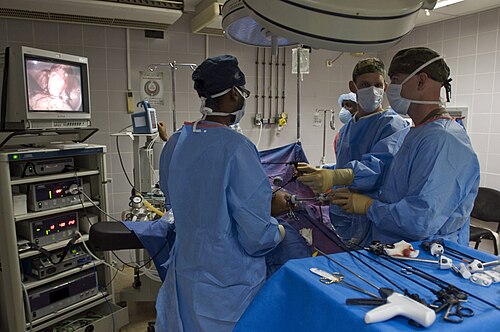
On September 12, 1985, Erich Muhe removed a gallbladder through a laparoscope instead of a wide incision. The German Surgical Society rejected his report in 1986, but the operation soon became standard and the approach spread to other abdominal operations.
Key people
- Erich Muhe
- German surgeon who performed the first laparoscopic cholecystectomy in 1985
- Philippe Mouret
- French surgeon who independently performed early video-laparoscopic cholecystectomy in 1987
- Francois Dubois
- French surgeon who published and trained widely in laparoscopic cholecystectomy technique
- Jacques Perissat
- French surgeon who contributed to early laparoscopic technique and its dissemination
Source
By the mid-1980s, cholecystectomy meant a right subcostal incision long enough to deliver a gallbladder through a small space, several days in hospital, and a convalescence measured in weeks. The operation was safe in experienced hands and had changed little since Carl Langenbuch performed the first cholecystectomy, in Germany, in 1882. Laparoscopes existed and were used routinely in gynecology for diagnostic procedures and tubal ligation, but the idea of using them for abdominal organ removal had not been translated into surgical practice in general surgery.
Erich Muhe, a general surgeon in Boblingen, Germany, made that translation on September 12, 1985. He removed a diseased gallbladder through an operating laparoscope of his own design, the galloscope, tying off the cystic structures with hemoclips from a pistol-grip applier and cutting between them with pistol-grip scissors. When he reported the operation to the German Surgical Society in 1986, he expected recognition. Instead, the society rejected his report. His 1990 paper to the American Journal of Surgery was also turned down, partly over his English. The society's recognition came on April 21, 1992, when it gave him its Anniversary Award and its president, Franz Gall, called the operation one of the greatest original achievements of German medicine in recent history.
Muhe performed 94 laparoscopic cholecystectomies before Philippe Mouret of Lyon did his first in 1987, followed by Francois Dubois of Paris in 1988; in the United States, J. Barry McKernan and William Saye performed the first on June 22, 1988, in Marietta, Georgia. Muhe never published his work in English, and in 1990 the Society of American Gastrointestinal and Endoscopic Surgeons (SAGES) honored Perissat, Berci, Cuschieri, Dubois and Mouret for early laparoscopic cholecystectomies but not him. In 1999 the same society recognized him as the first, inviting him to give its Storz Lecture.
Adoption after 1989 was rapid, and laparoscopic cholecystectomy soon displaced open surgery as the usual approach for symptomatic gallstones in industrialized countries. Patients went home sooner and returned to normal activity faster than after open surgery. The training infrastructure adapted accordingly: residency programs redesigned cholecystectomy as a laparoscopic procedure from the start, and open cholecystectomy became a skill taught primarily for conversion situations.
The consequences extended well beyond biliary surgery. Proof that a major abdominal organ could be safely removed through small ports prompted exploration of the same approach for appendectomy, inguinal and ventral hernia repair, colectomy, fundoplication, and adrenalectomy. Each operation required its own learning curve and instruments. Muhe had designed his galloscope after four packages of gynecological endoscopic instruments arrived at the Boblingen County Hospital in 1984.
Keep exploring
 Read next · led to
FDA Clearance of the da Vinci Surgical System (2000)
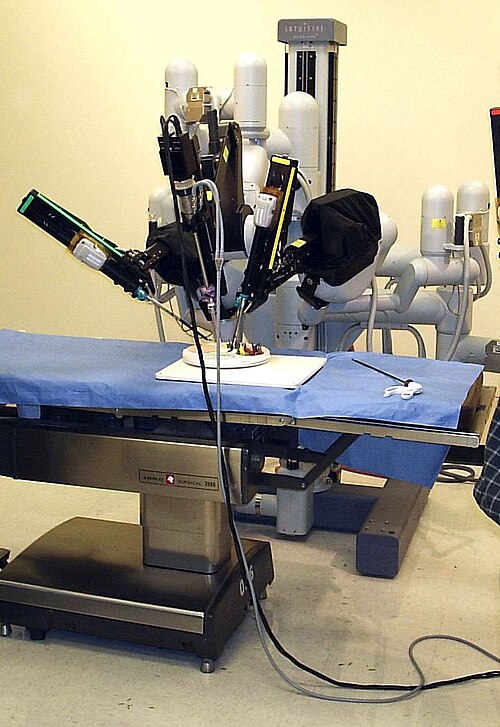
Laparoscopic surgery expanded from the late 1980s, and the da Vinci robot was cleared for such procedures in 2000. Its entry shows robots now common in gallbladder removal, hysterectomy and prostatectomy.
Read this moment
Read next · led to
FDA Clearance of the da Vinci Surgical System (2000)
Laparoscopic surgery expanded from the late 1980s, and the da Vinci robot was cleared for such procedures in 2000. Its entry shows robots now common in gallbladder removal, hysterectomy and prostatectomy.
Read this moment
 Today on The Clinical Times
Florida dengue outbreak appears to be largest in continental U.S. in decades
Florida has reported more than 250 locally acquired dengue cases this year, with most in Hillsborough County, according to state health officials.
Read today’s top stories
Today on The Clinical Times
Florida dengue outbreak appears to be largest in continental U.S. in decades
Florida has reported more than 250 locally acquired dengue cases this year, with most in Hillsborough County, according to state health officials.
Read today’s top stories
All 526 moments in the history of medicine. This one is in chapter 6, Trials, scanners and rights
Connected moments
How this moment links to others in the history of medicine, and what you will find in each.
- Same disease or problem1969Wolff and Shinya's colonoscopic polypectomyBoth used a scope to spare patients an open abdominal operation. The polypectomy entry shows colon polyps snared through a colonoscope, later linked to far fewer colorectal cancers.Read this moment
-
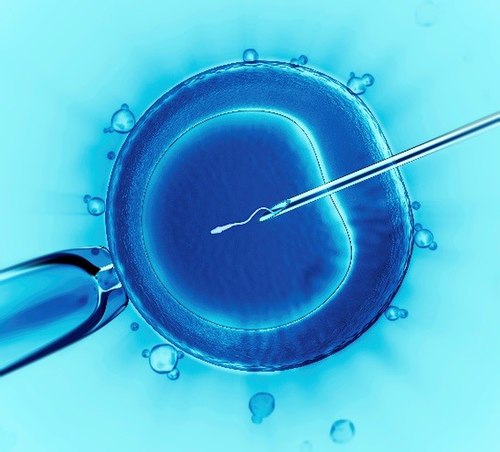 Same disease or problem1978Birth of Louise Brown: First Baby Conceived by In Vitro FertilizationLaparoscopes were routine in gynecology before Muhe, and Steptoe used one to collect eggs without open surgery. The IVF entry shows the birth of Louise Brown in 1978.Read this moment