Surgery & Anesthesia
2000
FDA Clearance of the da Vinci Surgical System
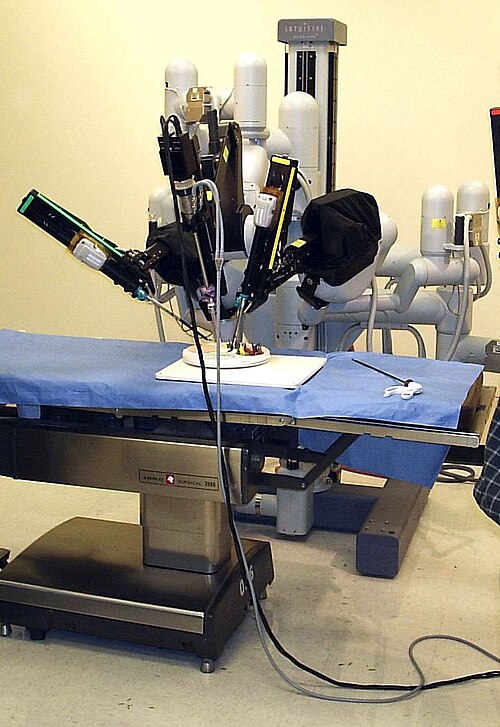
Cleared in July 2000 for general laparoscopic procedures, it became the first operative surgical robot in the United States. Robotic systems are now common in gallbladder removal, hysterectomy and prostatectomy.
Key people
- Frederic Moll
- Co-founder of Intuitive Surgical in 1995
- Mani Menon
- Henry Ford Hospital urologist whose team developed the Vattikuti Institute prostatectomy
- Ashutosh Tewari
- Vattikuti Urology Institute surgeon and first author of the 2003 comparison of robotic and open prostatectomy
Source
U.S. FDA 510(k) K990144, Intuitive Surgical da Vinci Surgical System. 2000. (opens in a new tab)
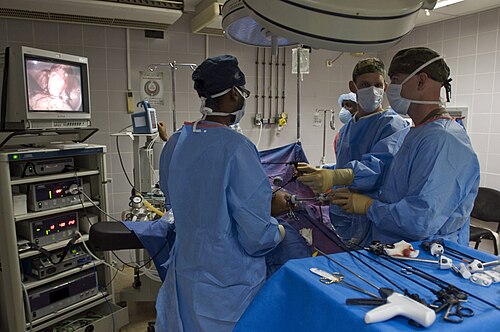
Laparoscopic surgery had been expanding since the late 1980s, driven by the benefits of smaller incisions, less postoperative pain, and faster recovery. The limitation was ergonomic and technical: instruments moved in counterintuitive directions through fixed ports, the two-dimensional camera reduced depth perception, and fine motor tasks in tight anatomical spaces strained even experienced surgeons. These constraints had held back adoption in procedures requiring precise suturing or complex dissection near critical structures. Robotic assistance was proposed as a way to restore the dexterity and visualization of open surgery while keeping the access advantages of a minimally invasive approach.
On July 11, 2000, after an application received in January 1999, the FDA cleared Intuitive Surgical's da Vinci system under 510(k) premarket notification K990144 to help control its instruments during laparoscopic procedures; the company had received a narrower clearance for its Monarch laparoscopic manipulator in 1997. The first version had three arms on a single patient cart, one for the endoscope and two for instruments; the surgeon viewed the field through a stereoscopic 3D viewer, and wristed instruments with seven degrees of freedom filtered out tremor and could scale motion down as much as five to one. The surgeon sat at the console in a non-sterile field while the patient-side cart and a surgical assistant managed the operative field. Frederic Moll had co-founded Intuitive Surgical in 1995 with Robert Younge, reworking a telepresence surgery system developed by Phil Green at SRI.
Urologists were among the early adopters of the system. In a 2003 single-institution comparison at Henry Ford Hospital, robotic prostatectomy had mean blood loss of 150 mL against 910 mL for open retropubic surgery, no transfusions against 67 percent, complications in 5 against 20 percent, and a hospital stay of 1.2 against 3.5 days; the patients were not randomized. Mani Menon's team at the hospital's Vattikuti Urology Institute in Detroit called their method the Vattikuti Institute prostatectomy and kept refining it.
The FDA now lists gallbladder removal, hysterectomy and prostatectomy among common procedures that may involve robotic systems. Randomized trials were more sobering. In a 2016 Australian trial, urinary and sexual function six weeks after robotic and open prostatectomy did not differ significantly, and in the 2017 ROLARR trial robotic rectal cancer surgery did not significantly reduce conversion to open surgery (8.1 percent against 12.2 percent for standard laparoscopy).
Intuitive merged with its rival Computer Motion, maker of the ZEUS robot, in 2003 after three years of legal disputes, and the FDA cleared a competing laparoscopic system, TransEnterix's Senhance, on October 13, 2017. In February 2019 the FDA issued a safety communication urging caution in the use of robotically assisted devices for mastectomy and other cancer-related operations.
Keep exploring
 Read next · built on
First Laparoscopic Cholecystectomy (1985)
The robot was cleared to assist laparoscopic surgery, which had been expanding since the first laparoscopic gallbladder removals. The Muhe entry shows the 1985 operation his surgical society first rejected.
Read this moment
Read next · built on
First Laparoscopic Cholecystectomy (1985)
The robot was cleared to assist laparoscopic surgery, which had been expanding since the first laparoscopic gallbladder removals. The Muhe entry shows the 1985 operation his surgical society first rejected.
Read this moment
 Today on The Clinical Times
Florida dengue outbreak appears to be largest in continental U.S. in decades
Florida has reported more than 250 locally acquired dengue cases this year, with most in Hillsborough County, according to state health officials.
Read today’s top stories
Today on The Clinical Times
Florida dengue outbreak appears to be largest in continental U.S. in decades
Florida has reported more than 250 locally acquired dengue cases this year, with most in Hillsborough County, according to state health officials.
Read today’s top stories
All 526 moments in the history of medicine. This one is in chapter 7, Genes and pandemics
Connected moments
How this moment links to others in the history of medicine, and what you will find in each.
- Same disease or problem1987The PSA test and prostate cancer screeningBoth concern prostate cancer, the robot as an early tool for removing the prostate and PSA as a test for finding the disease. The PSA entry shows screening's small benefit and heavy overdiagnosis.Read this moment
-
 Same disease or problemc. 1000Al-Zahrawi's illustrated surgeryA thousand years apart, both concerned the tools that extend a surgeon's hands, drawn instruments then and robotic arms now. Al-Zahrawi's entry shows the illustrated surgical book read in Europe for centuries.Read this moment