Foundational Discovery
1973
Lauterbur's NMR imaging (zeugmatography), origin of MRI
Lauterbur used magnetic field gradients to locate NMR signals in space and reconstruct images, a method he called zeugmatography. With Peter Mansfield's faster techniques, MRI followed; the two shared the 2003 Nobel Prize.
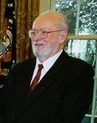
Key people
- Paul Lauterbur
- American chemist who conceived field-gradient spatial encoding of NMR signals.
- Peter Mansfield
- British physicist who developed echo-planar imaging, enabling fast MRI acquisition.
- Raymond Damadian
- Physician who showed NMR distinguishes tumor from normal tissue, spurring imaging research.
Source
Lauterbur PC. Nature. 1973;242:190-191. (opens in a new tab)
Nuclear magnetic resonance had been a laboratory technique since 1946, when Felix Bloch and Edward Purcell demonstrated it for protons, and it revealed molecular structure through the behavior of atomic nuclei in a magnetic field. By the early 1970s it was an established tool in chemistry, but no one had used it to produce spatial images. The equipment generated a single averaged signal from the entire sample; the information about where within that sample each nucleus was located was lost. In September 1971, after watching NMR measurements on tumor-bearing rats at a company near Pittsburgh, Paul Lauterbur, a chemist at the State University of New York at Stony Brook, saw that deliberately imposed gradients in the magnetic field could show where each signal came from.
In 1973 Lauterbur published a two-page letter in Nature titled 'Image Formation by Induced Local Interactions: Examples Employing Nuclear Magnetic Resonance.' He called his technique zeugmatography, a word he built from the Greek zeugma after checking it with a classical scholar. By applying linear magnetic field gradients from several directions and combining the resulting projections, he reconstructed a cross-section of two 1 mm capillaries of ordinary water inside a tube of heavy water, which no other imaging method could tell apart. Nature at first rejected the manuscript; Lauterbur appealed, added references to cancer and other medical uses, and the revised version was accepted.
Peter Mansfield at the University of Nottingham pursued a complementary direction. He showed how the gradient-encoded signals could be analyzed mathematically and devised echo-planar imaging, which collects a whole image in one very fast acquisition. Lauterbur's original method built images from projections, and early scans were slow: Mansfield's 1976 images of a student's finger, the first of a live human subject, each took 15 to 23 minutes. Echo-planar imaging became practical in patients only in the 1980s, after Mansfield's group found a way to switch gradients rapidly inside a superconducting magnet.
The transition from bench to clinical scanner required substantial engineering: superconducting magnets capable of whole-body bore sizes, radiofrequency coils matched to human anatomy, and computer systems that could reconstruct images quickly enough to be useful. The first MRI machines for hospitals became available in the early 1980s. Unlike CT, MRI used no ionizing radiation and could distinguish soft tissues more exactly, although patients with pacemakers or magnetic metal in the body could not be scanned.
Lauterbur and Mansfield shared the 2003 Nobel Prize in Physiology or Medicine. Raymond Damadian, who in 1971 had shown that rat tumors and normal tissues had different NMR relaxation times, took out advertisements in newspapers in the United States, Britain and Sweden arguing that he should have been included. In 2002, the year before the award, about 22,000 MRI scanners were in use worldwide and more than 60 million examinations were performed.
Keep exploring
 Read next · same disease or problem
First clinical CT scanner (EMI head scanner) (1971)
Both rebuilt cross-sections of the body by computer, CT from X-ray projections and MRI from magnetic signals. The CT entry shows the first scan of a patient, revealing a brain cyst in 1971.
Read this moment
Read next · same disease or problem
First clinical CT scanner (EMI head scanner) (1971)
Both rebuilt cross-sections of the body by computer, CT from X-ray projections and MRI from magnetic signals. The CT entry shows the first scan of a patient, revealing a brain cyst in 1971.
Read this moment
 Today on The Clinical Times
Florida dengue outbreak appears to be largest in continental U.S. in decades
Florida has reported more than 250 locally acquired dengue cases this year, with most in Hillsborough County, according to state health officials.
Read today’s top stories
Today on The Clinical Times
Florida dengue outbreak appears to be largest in continental U.S. in decades
Florida has reported more than 250 locally acquired dengue cases this year, with most in Hillsborough County, according to state health officials.
Read today’s top stories
All 526 moments in the history of medicine. This one is in chapter 6, Trials, scanners and rights
Connected moments
How this moment links to others in the history of medicine, and what you will find in each.
-
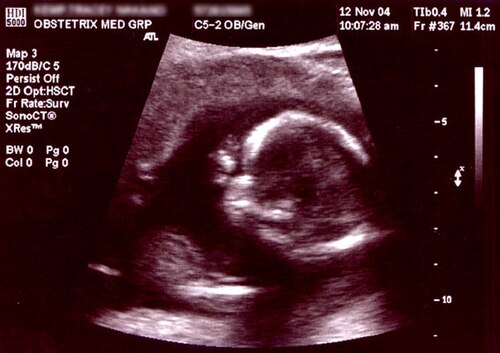 Same disease or problem1958Diagnostic medical ultrasound for obstetrics and abdominal masses (Donald)Both imaged soft tissue without ionizing radiation, one with echoes and one with magnetic fields. Donald's entry shows the Glasgow team that first imaged the fetus with ultrasound in 1958.Read this moment
-
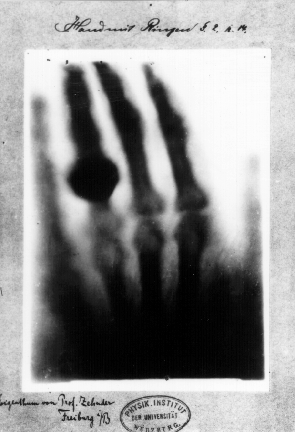 Same disease or problem1895Roentgen's discovery of X-raysMRI joined a line of ways to see inside the living body that began with X-rays. Roentgen's entry shows the 1895 discovery that started diagnostic radiology.Read this moment