Research Methods & Ethics
1972
Tuskegee Syphilis Study Exposed
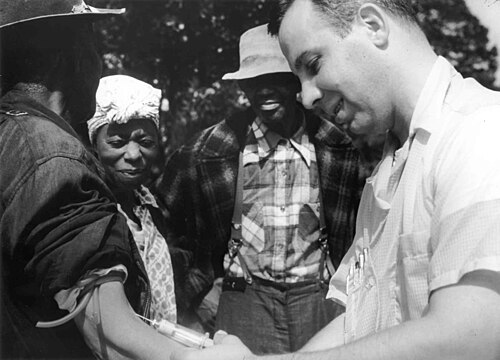
A federal study begun in 1932 followed 399 Black men with syphilis, and 201 without, while withholding treatment. Jean Heller's 1972 AP report led to its end and to the National Research Act, institutional review boards and informed consent rules.
Key people
- Jean Heller
- AP journalist whose July 1972 report made the study public.
- Peter Buxtun
- PHS venereal disease interviewer who objected to the study in 1966 and 1968, then went to the press.
- Edward Kennedy
- U.S. Senator who chaired hearings leading to the National Research Act of 1974.
Source
The study began in 1932 in Macon County, Alabama, a rural county still tied to its plantation past, where most of the men selected were poor sharecroppers. Working with the Tuskegee Institute, the U.S. Public Health Service enrolled 399 Black men with late-latent syphilis and 201 uninfected controls, offering them free medical exams, free meals and burial insurance. The aim was to record the natural history of untreated syphilis, an idea drawn from the Oslo study, in which Caesar Boeck had withheld treatment from almost 2,000 patients between 1890 and 1910. The men were not told they had syphilis; they were told they were being treated for bad blood.
By 1943 penicillin was the treatment of choice for syphilis and becoming widely available, but the men in the study were not offered it. When a PHS mobile treatment unit reached Macon County, staff told local doctors that each enrolled man was under study and not to be treated. Peter Buxtun, a PHS venereal disease interviewer, wrote to the CDC with moral objections in 1966 and again in November 1968. In February 1969 a CDC panel reviewed the study and decided against treating the men, although by then at least 28, and perhaps as many as 100, of them had died as a direct result of syphilis.
Buxtun eventually went to the press. Jean Heller's Associated Press story broke in the Washington Star on July 25, 1972, and was on the front page of the New York Times the next day. An Ad Hoc Advisory Panel recommended stopping the study in October 1972, and the Assistant Secretary for Health and Scientific Affairs announced its end in November, 40 years after it began.
Senator Edward Kennedy held hearings in February and March 1973. The advisory panel found the study ethically unjustified, and the CDC says there is no evidence that researchers ever obtained informed consent. Congress passed the National Research Act in July 1974, creating the National Commission for the Protection of Human Subjects of Biomedical and Behavioral Research. The commission's Belmont Report, submitted in 1978 and published in April 1979, set out three principles for research on human subjects: respect for persons, beneficence and justice.
The hearings and the act led to institutional review boards and to formal rules for informed consent. The government set up the Tuskegee Health Benefit Program in 1973 to give the survivors medical care, and a class-action lawsuit ended in a $10 million out-of-court settlement in 1974. On May 16, 1997, President Clinton apologized at the White House, where five of the eight surviving men attended. The last participant in the study died in January 2004.
Keep exploring
 Read next · same disease or problem
The Guatemala STD experiments exposed (2010)
Both were Public Health Service syphilis studies that harmed people, and the Guatemala records turned up while a historian searched for Tuskegee papers. That entry shows 1,308 people deliberately exposed to syphilis and other infections.
Read this moment
Read next · same disease or problem
The Guatemala STD experiments exposed (2010)
Both were Public Health Service syphilis studies that harmed people, and the Guatemala records turned up while a historian searched for Tuskegee papers. That entry shows 1,308 people deliberately exposed to syphilis and other infections.
Read this moment
 Today on The Clinical Times
Florida dengue outbreak appears to be largest in continental U.S. in decades
Florida has reported more than 250 locally acquired dengue cases this year, with most in Hillsborough County, according to state health officials.
Read today’s top stories
Today on The Clinical Times
Florida dengue outbreak appears to be largest in continental U.S. in decades
Florida has reported more than 250 locally acquired dengue cases this year, with most in Hillsborough County, according to state health officials.
Read today’s top stories
All 526 moments in the history of medicine. This one is in chapter 6, Trials, scanners and rights
Connected moments
How this moment links to others in the history of medicine, and what you will find in each.
- Led to1979The Belmont ReportThe Tuskegee hearings led to the National Research Act and the commission that wrote the Belmont Report. It shows the three principles, respect for persons, beneficence and justice, now guiding research on people.Read this moment
-
 Same disease or problem1910Ehrlich's Salvarsan for SyphilisSyphilis had a drug treatment from 1910, and penicillin by 1943, yet the Tuskegee men were left untreated. The Salvarsan entry shows Ehrlich's first magic bullet made to attack the syphilis germ.Read this moment
-
 Same disease or problem1947The Nuremberg CodeNuremberg made voluntary consent the first rule of research in 1947, while the Tuskegee study ran on for 25 more years. The Code shows how the verdict against Nazi doctors set out ten points for ethical research.Read this moment