Cardiology
1958
First implantation of a permanent cardiac pacemaker (Senning and Elmqvist)
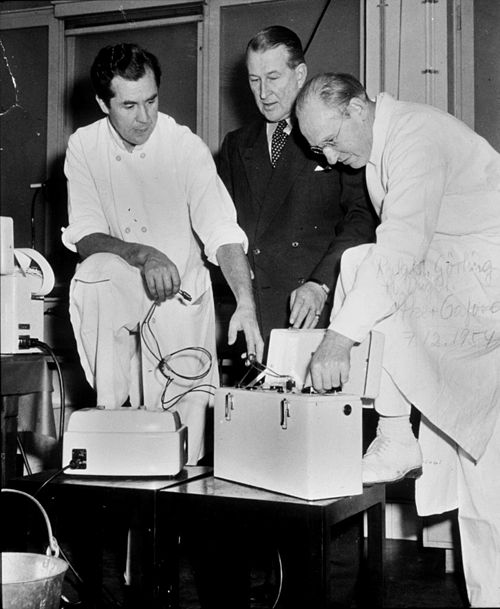
Surgeon Ake Senning implanted engineer Rune Elmqvist's transistor pacemaker in Arne Larsson on 8 October 1958 at Karolinska. The first unit failed after about eight hours and the second after about a week, but Larsson lived with implanted pacemakers until 2001.
Key people
- Ake Senning
- Cardiac surgeon who implanted the device at Karolinska Hospital.
- Rune Elmqvist
- Medically trained engineer who designed the transistorized pacemaker.
- Arne Larsson
- First recipient of a permanent implanted pacemaker; lived 43 years with devices.
- Seymour Furman
- Reported pacing the heart through an electrode passed along a vein in 1958 and 1959, the basis of transvenous pacing.
Source
Netherlands Heart Journal, 2008 (historical review) (opens in a new tab)
Before October 1958, patients with complete heart block could be paced only from outside the body, through skin electrodes or wires running out of the chest, which gave infection a route in. Arne Larsson, a 43-year-old engineer, had spent six months in hospital with complete atrioventricular block and 20 to 30 Stokes-Adams attacks a day despite drugs. His wife, Else-Marie, had read press reports about experiments on electrical stimulation of the heart and pressed Rune Elmqvist, a medically trained engineer at Elema-Schonander, and the surgeon Ake Senning to help. The two had been designing a fully implantable pacemaker but had not finished their animal experiments.
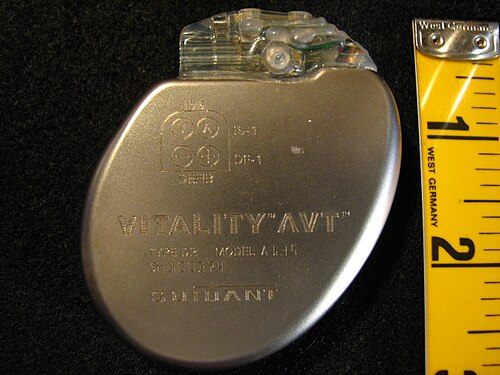
Senning, head of thoracic surgery at Karolinska Hospital in Stockholm, performed the implantation on the evening of October 8, 1958, when the operating rooms were empty. The device Elmqvist had built by hand was about the size of a shoe-polish tin, 55 mm across and 16 mm thick, powered by rechargeable nickel-cadmium batteries, and encased in epoxy resin. Through a left thoracotomy Senning sewed two wire electrodes into the heart muscle and tunneled them to the unit, which he placed in the abdominal wall. The first unit lasted about eight hours; Senning implanted the second early the next morning, and it worked for about a week before its pacing signal weakened, probably because a lead had broken.
Larsson needed pacing for the rest of his life. Over the next 43 years he received 22 pulse generators of 11 different models and five lead systems. He died on December 28, 2001, aged 86, of a cancer unrelated to his heart block or his pacemakers, having outlived both Elmqvist, who died in 1997, and Senning, who died in 2000.
Other groups moved quickly. In Buffalo, the engineer Wilson Greatbatch and the surgeons William Chardack and Andrew Gage paced a dog's heart with Greatbatch's implantable circuit on May 7, 1958; Chardack reported their first success in a patient in 1960. Seymour Furman in New York reported pacing the heart through an electrode passed along a vein in 1958 and 1959, and in 1962 Parsonnet's team in the United States and a Swedish group developed permanent transvenous leads. By the mid-1960s transvenous leads had replaced leads sewn onto the heart, and pacemakers could be implanted without opening the chest or giving general anesthesia.
Early devices failed often: batteries ran down, body fluids leaked into the casing, and leads broke. Demand pacemakers that fired only when the heart's own rate fell too low appeared in the mid-1960s. In the 1970s lithium-iodine batteries extended device life, titanium cases replaced epoxy and silicone, pacemakers became programmable from outside the body, and dual-chamber devices that paced both atria and ventricles followed by the end of the decade.
Keep exploring
 Read next · same disease or problem
Implantable cardioverter-defibrillator first human implantation (Mirowski) (1980)
Both put an electronic device inside the body to control a dangerous heart rhythm. The ICD entry shows Mirowski's implant that senses lethal ventricular arrhythmias and shocks them, now used to prevent sudden cardiac death.
Read this moment
Read next · same disease or problem
Implantable cardioverter-defibrillator first human implantation (Mirowski) (1980)
Both put an electronic device inside the body to control a dangerous heart rhythm. The ICD entry shows Mirowski's implant that senses lethal ventricular arrhythmias and shocks them, now used to prevent sudden cardiac death.
Read this moment
 Today on The Clinical Times
Florida dengue outbreak appears to be largest in continental U.S. in decades
Florida has reported more than 250 locally acquired dengue cases this year, with most in Hillsborough County, according to state health officials.
Read today’s top stories
Today on The Clinical Times
Florida dengue outbreak appears to be largest in continental U.S. in decades
Florida has reported more than 250 locally acquired dengue cases this year, with most in Hillsborough County, according to state health officials.
Read today’s top stories
All 526 moments in the history of medicine. This one is in chapter 5, Cures and codes
Connected moments
How this moment links to others in the history of medicine, and what you will find in each.
- Same person1977Grüntzig's coronary balloon angioplastyAke Senning, who implanted the first permanent pacemaker, later backed Andreas Grüntzig's first balloon angioplasty in Zurich. That entry shows how a balloon catheter widened a coronary artery in an awake patient in 1977.Read this moment
-
 Same disease or problem1960Closed-chest cardiac massageBoth kept failing hearts beating in the same years, one with electric pulses and one with chest compression. The CPR entry shows how pressing on the closed chest replaced opening it to massage the heart by hand.Read this moment