Oncology
1948
Aminopterin-induced remissions in childhood acute leukemia
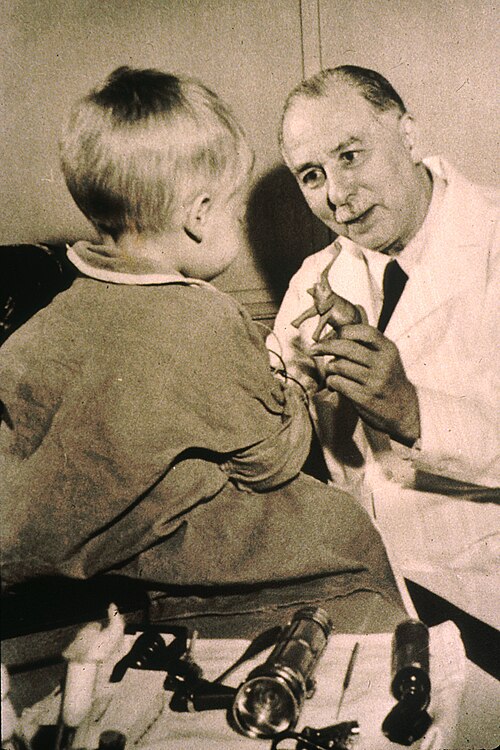
Farber gave aminopterin to 16 children with acute leukemia and saw 10 enter temporary remission, the first remissions of childhood leukemia produced by a drug. Nitrogen mustard had already shrunk a lymphoma at Yale in 1942.
Key people
- Sidney Farber
- Boston pediatric pathologist who designed and conducted the aminopterin trials
- Yellapragada SubbaRow
- Biochemist at Lederle Laboratories who synthesized the folate antagonists Farber tested
- Donald Pinkel
- St. Jude oncologist who developed the Total Therapy protocols that achieved long-term ALL remission
Source
In the mid-1940s, acute lymphoblastic leukemia in children was a uniformly lethal diagnosis. Median survival from diagnosis to death was measured in weeks to a few months. Most physicians regarded systemic drug treatment as futile; cancer was treated with surgery and radiation, and circulating malignancies seemed beyond the reach of any drug. Sidney Farber, the first full-time pathologist at Children's Hospital in Boston, disagreed, partly on theoretical grounds and partly because he had observed that folic acid appeared to speed the progression of leukemia in some patients.
That observation led Farber to test the opposite approach: blocking folate metabolism. Working with Yellapragada SubbaRow and colleagues at Lederle Laboratories, who had synthesized a series of folic acid antagonists, Farber obtained aminopterin, and with Louis K. Diamond he treated 16 children with acute leukemia between November 1947 and April 1948. Ten entered temporary remission, with clinical, blood and bone marrow improvement; most had been critically ill when treatment began. The findings appeared in the New England Journal of Medicine in June 1948.
The remissions were short. None lasted beyond several months, and all patients eventually relapsed and died. The paper drew criticism from academic colleagues, but parents and pediatricians wrote to Farber asking for guidance, and he answered many of the letters himself.
Methotrexate, less toxic than aminopterin and as effective, soon replaced it, and Farber's group also tried combining folate antagonists with corticosteroids and other agents. At the National Cancer Institute, Emil Frei and colleagues showed in 1961 that methotrexate combined with 6-mercaptopurine worked better against leukemia than either drug alone. By the 1960s, combination regimens using drugs with different mechanisms were being designed to prevent resistance.
At St. Jude Children's Research Hospital, Donald Pinkel and colleagues began the Total Therapy studies in 1962, combining multi-drug chemotherapy with treatment directed at the central nervous system. In Total Therapy Study V, begun in 1967, more than half of the children remained in remission after treatment ended and survived long term. In the past decade, five-year survival for children with ALL has exceeded 90 percent in most high-income countries.
Keep exploring
 Read next · same disease or problem
Nitrogen Mustard Chemotherapy (1946)
Nitrogen mustard had already shrunk a lymphoma at Yale in 1942, before Farber's leukemia remissions. The mustard story shows the first patient treated in secret and the bone marrow damage that followed.
Read this moment
Read next · same disease or problem
Nitrogen Mustard Chemotherapy (1946)
Nitrogen mustard had already shrunk a lymphoma at Yale in 1942, before Farber's leukemia remissions. The mustard story shows the first patient treated in secret and the bone marrow damage that followed.
Read this moment
 Today on The Clinical Times
Florida dengue outbreak appears to be largest in continental U.S. in decades
Florida has reported more than 250 locally acquired dengue cases this year, with most in Hillsborough County, according to state health officials.
Read today’s top stories
Today on The Clinical Times
Florida dengue outbreak appears to be largest in continental U.S. in decades
Florida has reported more than 250 locally acquired dengue cases this year, with most in Hillsborough County, according to state health officials.
Read today’s top stories
All 526 moments in the history of medicine. This one is in chapter 5, Cures and codes
Connected moments
How this moment links to others in the history of medicine, and what you will find in each.
-
 Led to1956Methotrexate for metastatic choriocarcinomaFarber's antifolates, aminopterin and methotrexate, were turned in 1956 against a solid cancer, choriocarcinoma. That story shows what was called the first drug cure of a widely spread cancer.Read this moment
-
 Led to1979Total Therapy / combination treatment curing childhood ALLFarber's remissions all relapsed, and St Jude's Total Therapy combined drugs and treatment of the brain to cure childhood leukemia. Its story shows childhood leukemia survival raised from near zero to roughly half.Read this moment