Public Health · 1961
Framingham Heart Study: the "risk factor" concept
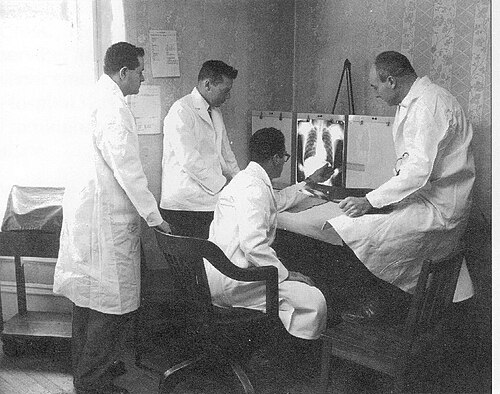
Before 1961, medicine had no standard term for a measurable characteristic that increased a person's probability of future disease without causing it directly. Clinicians noticed patterns: heavy smokers got more lung cancer, heavier patients had more heart attacks. But the conceptual apparatus to translate those observations into a systematic clinical tool was missing. The 1961 Framingham paper supplied it, coining 'risk factor' and demonstrating precisely what the phrase meant.
The paper showed that hypertension, hypercholesterolemia, and smoking each predicted coronary disease independently, and that their risks were roughly additive across six years of follow-up in 5,127 Framingham residents. A person carrying all three characteristics faced a substantially higher event burden than one with none. That additivity was clinically meaningful: it implied that partial intervention, reducing one risk factor even without eliminating others, would lower a patient's absolute risk.
The concept met real resistance at the time. Medicine in 1960 lacked widely accepted pharmacologic tools for treating hypertension; the thiazide diuretics were new, and most physicians were reluctant to treat asymptomatic blood pressure elevations. The diet-cholesterol-atherosclerosis chain was genuinely contested among researchers. Framingham did not resolve those debates but supplied the observational basis that randomized trials would eventually test.
Over the following decades, the risk-factor model extended far beyond cardiology. Oncology, endocrinology, and nephrology adopted similar frameworks for identifying patients at elevated probability of future events. The language of risk stratification, which now structures decisions about screening intervals, preventive medications, and treatment thresholds across nearly every specialty, derives from the vocabulary introduced in this paper.
The formal quantitative tools that clinicians use today, including the Pooled Cohort Equations for cardiovascular risk estimation, were built on the Framingham data. The 10-year risk score calculated at a patient's annual visit uses the analytic framework Kannel and Dawber published in 1961, applied to updated population samples and extended to include race and sex-specific coefficients.
Key People
- William Kannel — Principal analyst who introduced and defined the risk factor concept
- Thomas Dawber — Founding director of the Framingham Heart Study cohort
- William Castelli — Extended Framingham lipid findings; directed study for two decades
Ann Intern Med. 1961
Related landmarks
- 1964 · Surgeon General's Report on Smoking and Health (Public Health)
- 1956 · Water Fluoridation (Grand Rapids study, 10-year results) (Public Health)
- 1954 · British Doctors Study (Doll and Hill prospective cohort) (Public Health)
- 1968 · Oral Rehydration Therapy for cholera and diarrheal disease (Public Health)