Foundational Discovery
1895
Roentgen's discovery of X-rays
Roentgen found a radiation that passed through soft tissue but not bone, letting physicians see inside a living patient without cutting. The work won the first Nobel Prize in Physics in 1901 and started diagnostic radiology.
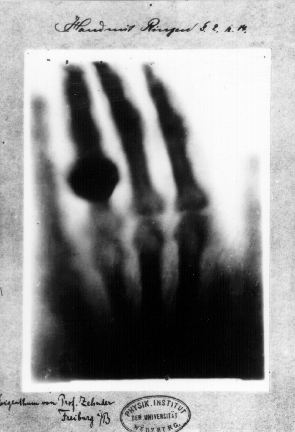
Key people
- Wilhelm Roentgen
- German physicist who discovered X-rays and described their imaging properties in 1895
- Anna Bertha Roentgen
- Roentgen's wife, subject of the first radiographic image of a human hand
Source
Sitzungsber Phys-Med Ges Wurzburg, 1895 (opens in a new tab)
Before November 1895, the interior of a living patient was accessible only by cutting. Surgeons relied on surface anatomy, percussion, and palpation to locate fractures, foreign bodies, and internal masses. The physical examination was the diagnostic limit. Wilhelm Roentgen was not working on a medical problem when he made his discovery; he was studying cathode rays in his laboratory at the University of Wurzburg, using a discharge tube sealed in thick black cardboard to keep visible light from escaping.
On the evening of November 8, 1895, Roentgen noticed that a paper screen coated with barium platinocyanide fluoresced when the tube was running, even when it lay two meters away. The cardboard blocked visible light, but something else was passing through it. Over the following weeks, working alone, he studied the new radiation: it passed through soft tissue but was stopped by bone and metal, and it could expose photographic plates. He named it X-strahlen, X-rays, because its nature was unknown. On December 22, 1895, he imaged his wife Anna Bertha's hand, capturing her bones and her wedding ring on a single photographic plate. Others had seen the effect without recognizing it: the American physicist Arthur Goodspeed had found unexplained circles left by coins on a photographic plate near a Crookes tube.
At the end of December 1895 Roentgen published his paper, "Uber eine neue Art von Strahlen" (On a New Kind of Rays), in the proceedings of the Wurzburg Physical-Medical Society. He sent reprints with sample radiographs to colleagues across Europe in early January 1896. The Vienna Presse and the London Standard reported the discovery within days, and by mid-January the rays were a worldwide sensation. In February 1896 Edwin Brant Frost used X-rays to diagnose a Colles fracture, and reports of fractures and foreign bodies found by X-ray soon filled the medical journals.
Within months, fairs offered X-ray booths, shoe stores used the rays to fit shoes, and Thomas Edison built a handheld fluoroscope. Armies saw the use at once: X-ray units were deployed in the Greco-Turkish War of 1897 and the Spanish-American War of 1898 to locate bullets and shrapnel in wounded soldiers. The hazards of ionizing radiation were not yet understood, and early radiologists and physicists suffered serious radiation injuries before protective practices developed.
Roentgen received the first Nobel Prize in Physics in 1901. He never patented the discovery and gave his prize money to his university. Fluoroscopy, angiography, and computed tomography all grew from the rays he described in 1895. Roentgen moved to the University of Munich in 1900 and died there on February 10, 1923, of intestinal cancer.
Keep exploring
 Read next · led to
Radium and the first radiation treatments (1896)
X rays burned the skin of those who first used them, and within months doctors aimed them at tumors and skin disease. That story shows the first radiation treatments and the radium that followed.
Read this moment
Read next · led to
Radium and the first radiation treatments (1896)
X rays burned the skin of those who first used them, and within months doctors aimed them at tumors and skin disease. That story shows the first radiation treatments and the radium that followed.
Read this moment
 Today on The Clinical Times
Florida dengue outbreak appears to be largest in continental U.S. in decades
Florida has reported more than 250 locally acquired dengue cases this year, with most in Hillsborough County, according to state health officials.
Read today’s top stories
Today on The Clinical Times
Florida dengue outbreak appears to be largest in continental U.S. in decades
Florida has reported more than 250 locally acquired dengue cases this year, with most in Hillsborough County, according to state health officials.
Read today’s top stories
All 526 moments in the history of medicine. This one is in chapter 4, Germs, numbers and clean water
Connected moments
How this moment links to others in the history of medicine, and what you will find in each.
-
 Led to1971First clinical CT scanner (EMI head scanner)Computed tomography grew from Roentgen's rays, with a computer building cross sections from X ray beams at many angles. The CT story shows the first scan of a patient's brain in London in 1971.Read this moment
-
 Same disease or problem1956Alice Stewart and prenatal X-raysThe hazards of X rays were not understood at first, and in 1956 Alice Stewart linked X rays in the womb to childhood cancer. Her story shows the survey that led to fewer antenatal X rays.Read this moment
-
 Same disease or problem1761Auenbrugger's percussion of the chestBefore X rays, doctors found disease inside the body by tapping and listening, the method Auenbrugger taught. His story shows how he learned the sounds of a diseased chest, partly by filling corpses with fluid.Read this moment